
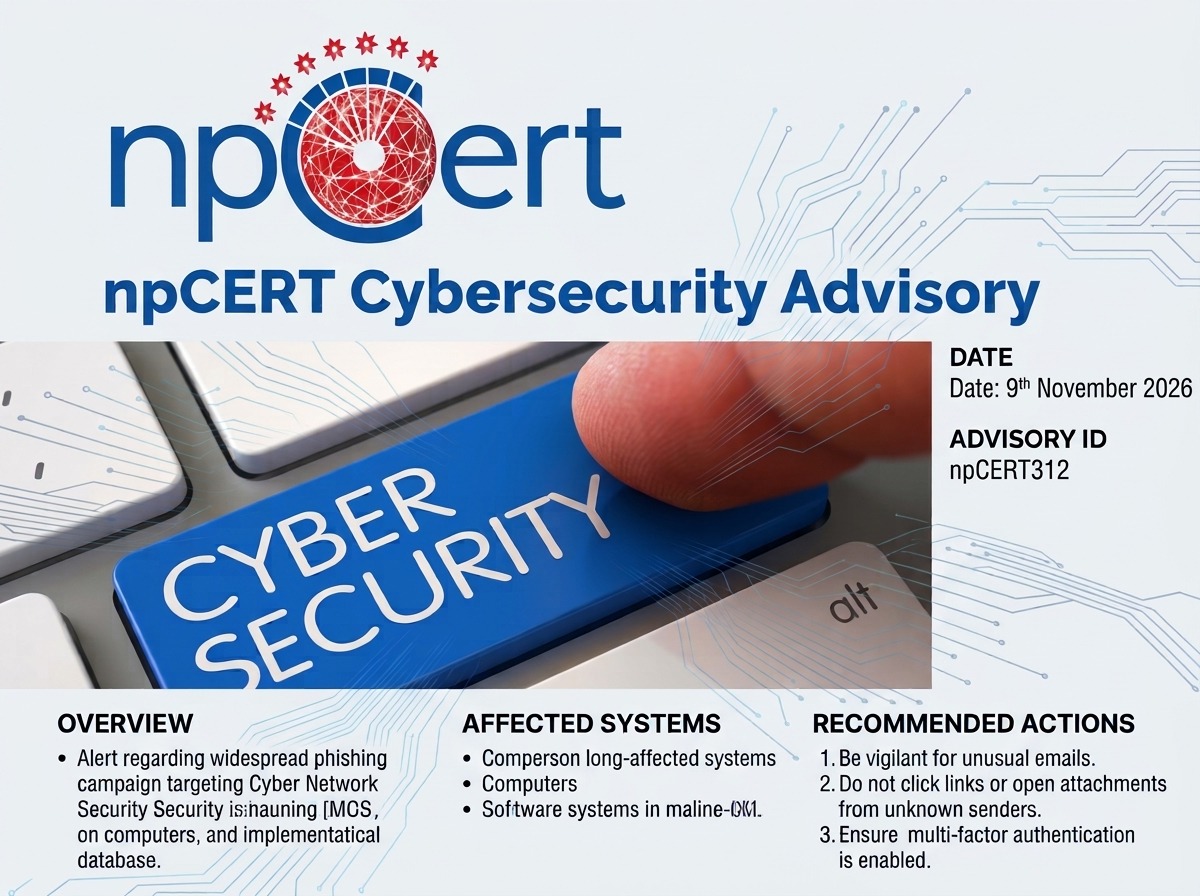
Kathmandu – As the festival season approaches in Nepal, digital payments and online transactions witness a rapid surge. However, cybercriminals equally exploit this opportunity to scale up their malicious activities. In this context, the Information Security Response Team Nepal (npCERT) has issued the Cyber Security Advisory 2026, directing the banking sector, payment service providers, and the general public to maintain high vigilance.
According to the Cyber Security Advisory 2026 (npCERT/2026-2027) released by npCERT, there is a high likelihood of lethal cyberattacks such as Phishing, Ransomware, and Distributed Denial of Service (DDoS) targeting financial systems and personal accounts during the festive period.
The npCERT Cyber Security Advisory 2026 highlights five crucial technical security measures for banks, financial institutions, Payment System Operators (PSO), and digital financial app service providers:
24/7 SOC Monitoring: Keep Security Operations Centers (SOC) active round-the-clock to immediately identify suspicious activities within online transactions and systems.
Phishing Protection & Email Filtering: Implement strict filtering mechanisms to prevent fake emails and messages sent in the name of festival discounts, offers, or gifts from penetrating institutional systems.
Patch Management & RASP: Timely apply security patches to servers, VPNs, and mobile banking applications, and update them using Runtime Application Self-Protection (RASP) technology.
Anti-DDoS Protection & Air-gapped Backups: Coordinate with ISPs to activate Anti-DDoS systems to prevent service disruption attacks, and maintain secure offline (air-gapped) backups of core data.
Fraud Surveillance & Control: Automatically track unusual or high-value transactions, and immediately freeze accounts or initiate action upon detecting suspicious activity.
The Cyber Security Advisory 2026 recommends three primary precautions for general consumers to avoid financial fraud during the festive season:
Beware of Fake Offers, Gifts, and Lotteries: Do not click on attractive links promising “cashback,” “gifts,” or “lottery wins” received via social media, SMS, or WhatsApp.
Keep OTPs, PINs, and Passwords Confidential: No bank or digital wallet (such as eSewa, Khalti, etc.) will ever request your OTP (One-Time Password), PIN, or password over the phone or via message. Never share these credentials with anyone.
Avoid Banking Transactions on Public Wi-Fi: Do not conduct mobile banking or online payments using open, public Wi-Fi networks available at bus stations, cafes, or public places.
Supported by the Center for Cyber Security Research and Innovation (CSRI Nepal)—a premier think tank active in emerging technologies, digital policy, and science-based governance—the official advisory (npCERT/2026-2027) highlights the vital security measures required by banks, financial institutions, payment system providers, and consumers in Nepal to stay safe from phishing, DDoS attacks, and digital fraud during the holidays.
If you encounter suspicious online activity, phishing messages, or fall victim to banking fraud, immediately contact your respective bank or financial institution to block your account. Furthermore, the Cyber Security Advisory 2026 urges victims to report the details of the incident to the Nepal Police Cyber Bureau.





FACEBOOK COMMENTS