
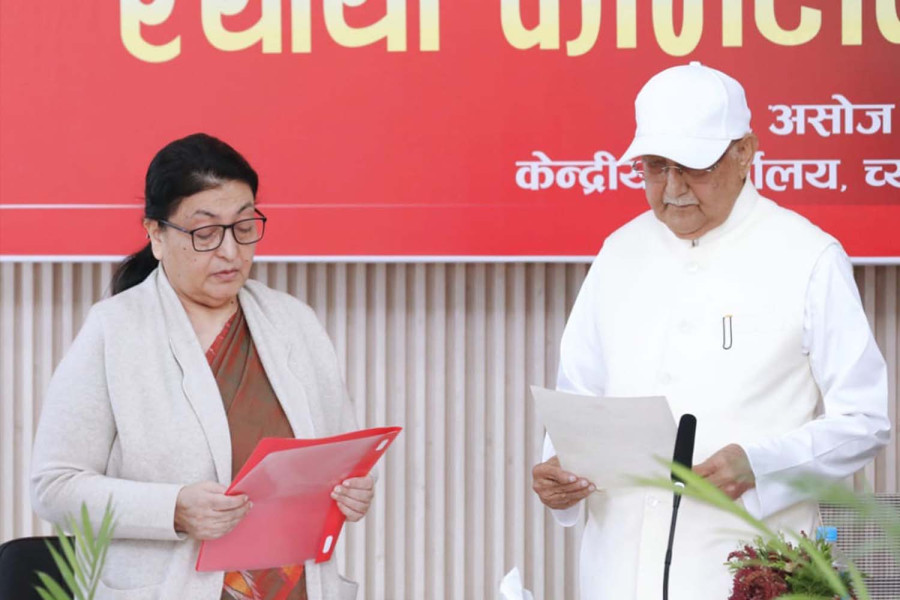
KATHMANDU: Former President Bidya Devi Bhandari has formally returned to active politics in the CPN-UML, 11 years after stepping away from party responsibilities to assume the country’s highest constitutional office.
At a Standing Committee meeting on Thursday, UML Chair and former Prime Minister KP Sharma Oli administered the oath to Bhandari, who was recently appointed senior leader of the party. Under the new arrangement, she ranks second after Oli, placing her at the centre of the party’s internal power dynamics.
The UML Central Committee created the senior leader position by invoking a statutory provision designed to remove obstacles, although the party’s existing statute did not explicitly recognise the post. The arrangement is expected to be presented at the party’s next statute convention.
Bhandari served as President for two consecutive terms, from October 2015 to March 2018 and from March 2018 to March 2023. Before becoming President, she was a UML vice-chair. After leaving office, she remained active in public life through the Madan Bhandari Foundation, established in memory of her late husband.
Bhandari’s return comes at a sensitive time for the UML, which has faced growing internal pressure to review its leadership following its poor performance in the March 5 parliamentary election. The party won seven first-past-the-post seats and 18 proportional representation seats, leaving it with 25 seats in the House of Representatives, compared with 78 in the previous House.
Her elevation is also taking place amid growing differences between Oli and leaders who have called for organisational and leadership restructuring, including Vice-chair Bishnu Paudel, General Secretary Shankar Pokharel, Vice-chair Gokarna Bista and Raghu Panta.
A UML leader suggested that Bhandari’s return could also serve as a political message to those demanding leadership changes, while potentially positioning her for a larger role in the party’s future leadership.
Oli’s decision to elevate Bhandari follows months of internal debate over her political status. An office-bearers’ meeting held at Oli’s residence in Gundu in May had agreed to restore her party membership. The Central Committee subsequently appointed her senior leader.
Bhandari has said she returned without personal ambition. Speaking in Butwal on September 29, she said she had initially been uncertain about accepting the responsibility but agreed after repeated requests from party leaders.
“There was uncertainty about whether I should take responsibility now, but when people from all sides began inviting me in recognition of my seniority and past contribution, I accepted,” Bhandari said. “I have returned to take responsibility again to build the party and the country. After reaching the highest constitutional post, I have no desire for any position or personal interest.”
Since her return, Bhandari has called for an open review of the party’s leadership, working methods and the broader communist movement.
Bhandari’s return has reignited debate over whether former heads of state should re-enter active partisan politics after leaving office.
Political scientist Hari Sharma, a former adviser to President Ram Baran Yadav, said the Constitution does not expressly prohibit a former President from joining active party politics. However, he argued that the issue involves ethical considerations beyond legal restrictions.
“The constitution does not stop a former president from active party politics. This is a moral question. The presidency is an impartial institution. It is defined as the highest institution created by the constitution and a symbol of the republic,” Sharma said.
He added that a person who has held the presidency should ideally remain outside active party politics to preserve the dignity and impartiality associated with the office.
“The presidency should be kept above political merits and demerits. Therefore, the presidency we have imagined should remain outside parties,” he said.
Sharma also warned that decisions taken by a President while in office could become subjects of partisan controversy once the former office-holder returns to party politics. He noted that former presidents in neighbouring India had not returned to active politics, unlike former executive presidents in some other countries.
Constitutional expert Bipin Adhikari also questioned the compatibility of a former President’s return to party politics with the dignity of the office.
“Much of the governance system is not laid out in the constitution. The protocol of national honour places the president at the highest level. Therefore, it is not customary for a president to act below the dignity of the office,” Adhikari said.
He added that the President receives confidential information relating to the administration, security agencies, the government and the military while in office. In his view, returning to partisan politics after holding such a position raises questions about the conventions expected of a former head of state.
Alongside Bhandari, former Vice-president Nanda Bahadur Pun has also returned to active politics. Pun has reunited with leaders of the Nepali Communist Party, formed through the merger of several leftist parties, including his former Maoist party.
UML leader Binda Pandey, however, said Bhandari’s elevation to the party’s second rank would not necessarily bring fundamental changes to the organisation.
She argued that the party should focus on public concerns and tangible results rather than concentrating primarily on positions and internal appointments.
“The main question is how many issues affecting the people have we raised and will raise. Women’s leadership cannot be developed merely by bringing women into party committees. But people are looking for results, while we are preoccupied with positions,” Pandey said.
Her remarks highlight a wider question facing the UML: whether Bhandari’s return will lead to substantive organisational reform or further intensify the party’s internal competition for leadership.







FACEBOOK COMMENTS