
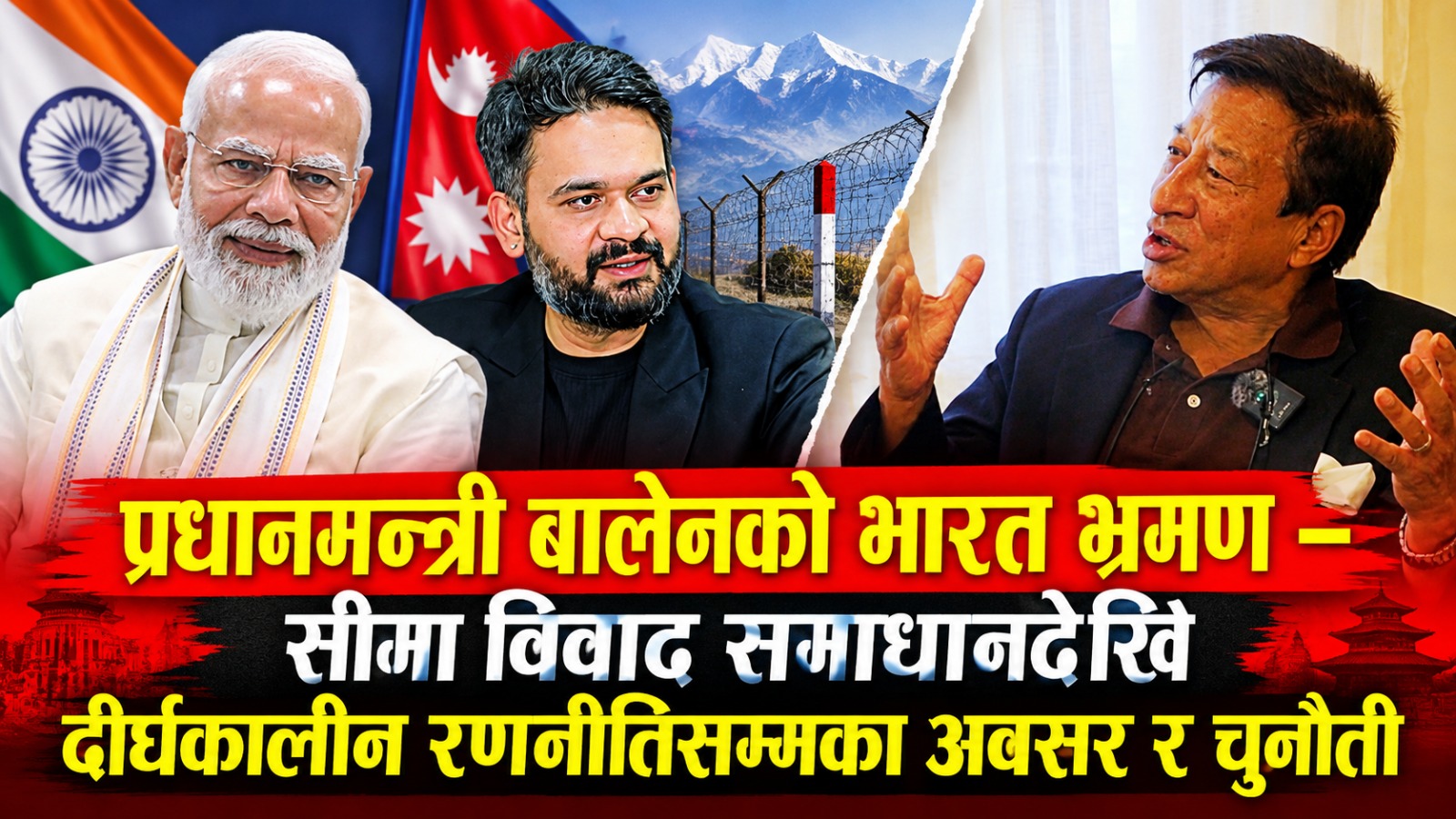
Kathmandu : Debate has begun over Prime Minister Balen Shah’s upcoming visit to India. There is considerable public interest in what the visit will look like, particularly because Prime Minister Shah is not known for holding meetings with people unnecessarily and prefers visits that deliver tangible outcomes.
The Office of the Prime Minister and Council of Ministers and the Ministry of Foreign Affairs are currently preparing for the visit. It is also being viewed as an opportunity to improve Nepal–India relations, which have reportedly faced difficulties in recent times.
In this context, Corporate Khabar spoke with Dr. Durgeshman Singh, former Ambassador of Nepal to India, about the opportunities and challenges surrounding the Prime Minister’s visit. Edited excerpts of the interview follow.
Prime Minister Balen Shah’s visit to India is currently being planned. How do you view this visit? What are the major opportunities and challenges for the Prime Minister?
The biggest challenge for the Prime Minister is to establish a long-term understanding with India. Nepal–India relations should not be driven by temporary political sentiments or domestic political interests. Foreign policy must be based on long-term national interests.
Nepal needs to clearly define its national and economic interests in its relationship with India. The Prime Minister should engage in open dialogue with Indian leaders and clearly communicate Nepal’s priorities and commitments. The practice of saying one thing in Nepal and something different in India must come to an end.
Nepal and India have several longstanding issues, including border disputes. How should the Prime Minister raise these matters?
It would be unrealistic to expect all longstanding issues, including border disputes, to be resolved in a single meeting. The existing mechanisms and diplomatic dialogue between the two countries need to be made more effective.
Both countries must respect past agreements and commitments while maintaining continuity in state policies. If any existing agreement needs to be revised, both sides should seek a mutually acceptable solution through dialogue and diplomatic channels.
Nepal must move forward while safeguarding its independent foreign policy and national interests.
How can Nepal prioritise its national interests in its relationship with India?
In international relations, there are no permanent friends or permanent enemies; there are permanent national interests. Nepal must clearly identify its national and economic interests.
Relations with India should not be based merely on emotional slogans. They should be founded on mutual benefits and practical cooperation. Nepal must clearly communicate its priorities, while also helping India understand that Nepal’s stability and prosperity are in its own interest.
How can Nepal cooperate with India to turn its landlocked geographical position into a geopolitical and economic opportunity?
Connectivity is one of the most important factors for Nepal’s development. Economic prosperity is difficult to achieve without the development of roads, railways, air services and other infrastructure.
Nepal should expand its connectivity networks with India and transform its geographical position into an opportunity. Both India and China are rapidly developing their infrastructure, and Nepal should also benefit from these developments.
For this, the government needs to invest in infrastructure and encourage the private sector to expand industries, trade and employment opportunities.
What impact could the proposed railway connectivity between Ayodhya and Janakpur have on tourism and bilateral relations?
Expanding railway connectivity between Ayodhya and Janakpur would be a positive initiative. However, establishing railway services alone is not enough. Nepal needs to create an environment that encourages tourists arriving from India to stay in the country for four or five days.
Tourism circuits could be developed by connecting Janakpur with Chitwan, Pokhara and other tourist destinations. This would benefit tourism businesses, create employment and support local economies. It would also further strengthen people-to-people relations between the two countries.
Several infrastructure projects between Nepal and India have been announced, but some have taken years to complete. What are the main reasons behind these delays?
One of the major problems in Nepal’s development process is the failure to complete projects on time. A project that should be completed in four years sometimes takes ten years. This increases project costs and places an additional financial burden on the country.
The government should not merely announce projects; it must establish a system that ensures their timely completion. Monitoring, coordination and implementation mechanisms for projects between Nepal and India need to be made more effective.
Timely completion of projects would also increase the confidence of foreign investors.
What should the Prime Minister do to make Nepal’s economic diplomacy with India more effective?
Economic diplomacy should be an important foundation of Nepal’s foreign policy. India is a major market, and Nepal should make better use of its consumer market and business opportunities.
Nepal should focus on projects that benefit both countries. Cooperation can be expanded in hydropower, tourism, industry, trade and employment generation.
We must clearly communicate that India can also benefit from stronger economic relations with Nepal. Therefore, economic diplomacy should not remain limited to slogans; it must produce visible results.
What areas should the government prioritise to reduce Nepal’s trade deficit with India?
Nepal needs to increase its exports to reduce the trade deficit with India. For this, it is essential to expand production capacity, establish industries and focus on producing quality goods.
India’s states of Uttar Pradesh and Bihar, in particular, offer significant market opportunities for Nepal. Nepal can increase the reach of its products in these markets. However, this requires reducing production costs, maintaining quality standards and making trade-related procedures easier.
The Pancheshwar Multipurpose Project has been under discussion for a long time. Why has its implementation been delayed?
The Pancheshwar Project is important for both Nepal and India. It has the potential to generate hydropower, support irrigation and deliver other economic benefits. However, despite years of discussions and agreements, its implementation has not moved forward as expected.
Both countries need to give this project priority and resolve the remaining technical and other disputes. Moving the project forward would benefit not only Nepal but also India. What is needed is political will and practical cooperation.
What strategy should Nepal adopt to maintain balanced relations with both India and China?
Nepal should move forward in its relations with both neighbouring countries by placing its national interests at the centre. Even if there is competition between India and China, Nepal should not adopt a policy of using one country against the other.
Nepal should make use of its geographical position as an opportunity. It can expand trade, infrastructure, tourism and economic cooperation with both countries. At the same time, Nepal must maintain an independent foreign policy and preserve its right to make independent decisions.






FACEBOOK COMMENTS