
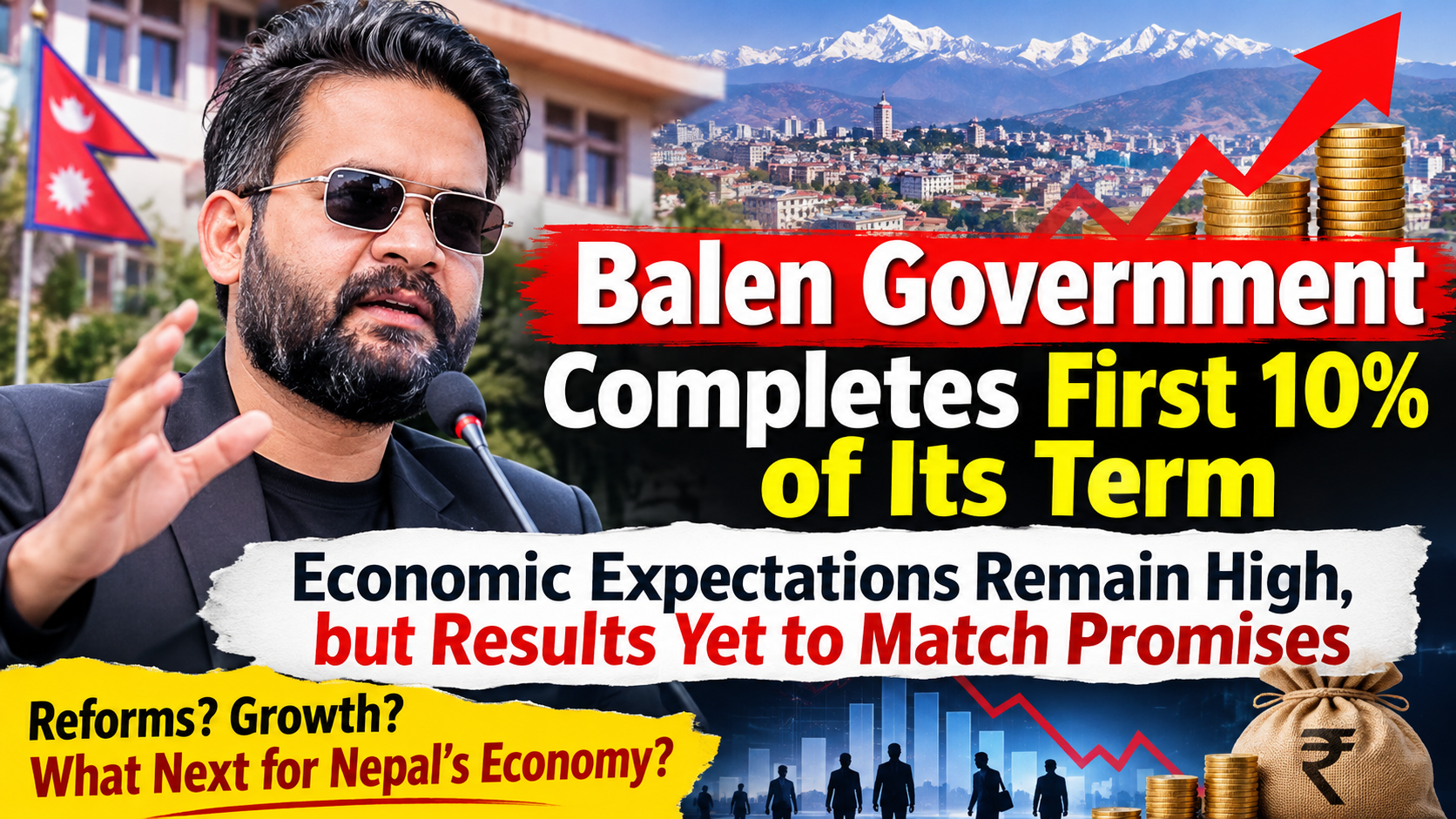
Kathmandu : The government led by Prime Minister Balendra Shah (Balen), which came to power with a historic public mandate on the promises of good governance and economic prosperity, has completed 10 percent of its five-year term. When the government was formed on Chaitra 13, citizens, industrialists, businesspeople and investors expected good governance, policy stability, increased investment and faster public service delivery. However, the economic picture during the government’s first six months suggests that the gap between expectations and achievements remains considerable.
The government has announced several packages of economic reforms. The prime minister has held repeated discussions with industrialists and businesspeople and reiterated his commitment to addressing the problems faced by the private sector. Efforts have also been made to digitise public services and reduce intermediaries within government mechanisms. However, these announcements and commitments have yet to translate into tangible economic improvements. The key question is no longer how many decisions the government has made, but how much change those decisions have brought to the economy.
The share market, often regarded as a barometer of the economy, has continued its downward journey since the formation of the government. Stock market fluctuations are influenced by several factors, including interest rates, liquidity, the financial health of companies, investor confidence and the overall economic environment. Therefore, it would be inaccurate to attribute the market’s decline solely to government performance. However, a government that came to power with a strong public mandate must be able to restore confidence among investors. What the market needs is not merely political rhetoric, but stable policies, a clear direction for reform and confidence in the country’s economic future.
Despite excess liquidity in the financial system, private-sector demand for loans has not increased as expected. Industrialists and businesspeople do not appear sufficiently encouraged to make new investments. Production, employment and domestic demand have yet to gain the expected momentum. A situation in which money accumulates in banks while investment remains sluggish reflects a contradiction in the economy, largely associated with a weak investment climate.
Adequate foreign exchange reserves and remittance inflows have been positive factors in supporting the external sector. However, remittances alone cannot be considered a measure of sustainable prosperity. An economy dependent on money sent home by migrant workers cannot achieve long-term stability without expanding domestic production and employment. The money earned through the hard work of Nepali workers abroad continues to support imports, while the country struggles to strengthen its own productive capacity.
The government’s approach towards the private sector has also had a significant impact on business confidence. The incident involving the arrest of prominent businesspeople by police has created unease in the business community. Individuals suspected of corruption, fraud or other unlawful activities must be investigated and held accountable. However, such action must be based on the rule of law, evidence, impartial investigation and due process. Actions taken without completing legal procedures, or a tendency to declare someone guilty before the allegations are proven, can undermine confidence in the private sector.
Investors need the rule of law, not a climate of fear. The government’s objective should not be to protect the guilty or provide them with immunity, but to ensure that the innocent are not intimidated and that those found guilty are dealt with in accordance with the law.
In this context, the positive initiatives shown by the Rastriya Swatantra Party (RSP) and its chairperson, Rabi Lamichhane, towards the private sector also deserve attention. After the elections, Lamichhane held discussions with private-sector leaders on his own initiative. The party’s announcement that it was prepared to address the concerns and demands of the private sector raised expectations among industrialists and businesspeople. Revitalising the economy is not solely the responsibility of the government; political parties also have an important role to play.
Listening to the concerns of the private sector and expressing a commitment to address them is a positive beginning. However, dialogue and assurances alone are not enough. The private sector must experience policy stability, investment security, clarity in the tax system and a more business-friendly operating environment in practice. Only when the RSP translates its commitments into concrete policy initiatives and effective implementation can they have the expected impact on the economy.
Policy stability is equally important. Some tax-related provisions introduced through the budget appeared to have been formulated without adequate study and consultation. The need to revise decisions within a short period following disputes and opposition has raised questions about the preparedness behind policymaking. Tax policy is not merely a matter of government revenue; it also influences production costs, consumer prices, investment returns and business expansion. Therefore, adequate research, consultation with stakeholders and an assessment of implementation impacts must be essential before announcing economic policies. Frequent policy changes make it difficult for investors to formulate long-term plans.
The government has also failed to demonstrate an effective response to rising prices. Although official statistics may indicate relatively limited inflation, ordinary citizens continue to feel the pressure of rising costs in essential areas such as food, vegetables, education, healthcare and transportation. Wholesale prices and average inflation indicators alone cannot fully capture the actual cost of living. Without effective market monitoring, supply management and control of intermediaries, people’s purchasing power continues to weaken. The real test of economic reform is not limited to the stock market or revenue figures; it must also be reflected in the prices citizens pay for everyday necessities.
The government also needs to assess its performance in revenue mobilisation. Higher imports may increase customs revenue, but that alone cannot be considered an achievement of a production-oriented economy. Sustainable revenue growth must be based on domestic production, employment, business expansion and rising incomes.
Similarly, although the announcement of digital public services is a positive step, implementation remains a challenge. Citizens continue to face difficulties due to dependence on paperwork, poor coordination among government agencies and administrative inefficiencies. Weaknesses in relief distribution, reconstruction planning and institutional preparedness following natural disasters have further tested the government’s delivery capacity.
Nevertheless, it would be premature to draw a final conclusion about the government’s performance after just six months. Ninety percent of its five-year term remains. Moving away from established political practices and reforming administrative structures are not easy tasks. However, the government received a strong public mandate precisely to confront these challenges. It can no longer use its lack of experience as an excuse for weaknesses. It has a responsibility to acknowledge mistakes, correct decisions and demonstrate measurable results.
The Balen government must continue its dialogue with the private sector, but it must now turn that dialogue into action. Guarantees of investment security, clear and stable tax policies, incentives for productive industries, effective market monitoring, reliable digital public services and preparedness for disaster management must be among its priorities.
Likewise, the RSP and other political parties must translate their commitments to resolving private-sector problems into policy reforms and practical cooperation. The time has come to assess economic reform packages not by the number of announcements made, but by how many jobs they create, how much new investment they attract and how much easier they make people’s lives.
A strong public mandate is an opportunity for the government, not a certificate of achievement. The first 10 percent of its term has generated more questions than confidence in the economy. The remaining 90 percent offers the government an opportunity to correct its course and turn its commitments into measurable outcomes.
History will judge the Balen government not by how many announcements it made, but by how effectively it revitalised the economy, restored private-sector confidence and improved the everyday lives of ordinary citizens.







FACEBOOK COMMENTS