

Kathmandu: Prime Minister Balen Shah is preparing to visit India on Mangsir 6 (November 22).
There is considerable discussion about the agenda he should raise during the visit and the issues he should discuss with his Indian counterpart, Narendra Modi.
The Prime Minister has repeatedly stated that he does not intend to undertake a ceremonial visit. There is widespread public interest in what outcomes his India visit will deliver. A delegation comprising four ministers, some members of the Prime Minister’s Secretariat and business representatives is also preparing to accompany him to India.
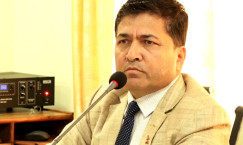
In this context, Corporate Khabar spoke with Dr Prakash Chandra Lohani, former Finance Minister, former Foreign Minister and senior leader of the Rastriya Prajatantra Party.
Prime Minister Balen Shah is making final preparations for his India visit. The government says it is working to make the visit productive. How should the Prime Minister present himself during this visit?
India is our neighbouring friendly country. Nepal and India should develop relations based on mutual trust, goodwill and shared interests. Both countries have a responsibility to work towards this objective. We expect the Prime Minister to take initiatives in this direction.
In today’s world, strong political and diplomatic relations alone are not sufficient to strengthen relations between two countries. Economic relations must also be equally strong. This is particularly important because both countries, regardless of their size, are sovereign nations. Economic relations should be expanded on the basis of mutual interests and benefits.
Fortunately, Nepal is situated between two major economies, China and India, which are developing rapidly to its north and south. We must view this situation as an opportunity rather than a challenge. Nepal should maximise the economic benefits of its relations with both countries.
India should also recognise Nepal’s economic development as being in its own interest. An economically strong and prosperous Nepal would benefit India as well. A capable Nepal is also important from the perspectives of security, economic growth and regional stability. Therefore, the Prime Minister should clearly communicate the need for India’s support and cooperation in Nepal’s economic development.
What economic issues should the Prime Minister prioritise during his visit?
Increasing production and expanding trade should be the major priorities for Nepal’s economic development. A substantial portion of Nepal’s total foreign trade takes place with India. Therefore, Nepali products should have easier access to the Indian market. In particular, concrete initiatives are necessary to remove obstacles to the export of Nepali agricultural products.
Various agreements have been signed between Nepal and India to facilitate bilateral trade. However, Nepali products continue to face numerous obstacles in practice.
For example, Nepali tea, cardamom and other agricultural products sometimes have to wait between 15 and 20 days at Indian border points in the name of quality testing. This causes financial losses to Nepali businesses and discourages exports.
To address such problems, quality-testing laboratories should be established in Nepal’s border areas. This would allow Nepali products to be tested immediately. Products that meet the required quality standards could enter the Indian market without unnecessary delays, while those failing to meet the standards could be returned.
This would help eliminate unnecessary delays and non-tariff barriers in bilateral trade. Similarly, Nepal should focus on producing goods that are in demand in India’s enormous market. For example, millions of motorcycles are used in India.
Nepal has the potential to manufacture various motorcycle spare parts. By collaborating with Indian industries, production units could also be established in Nepal. This would create employment opportunities and generate economic benefits for Nepal.
In today’s global economy, no single country produces everything on its own. A product may be designed in one country, manufactured in another and packaged in a third. This is known as production sharing, or participation in product-sharing and supply-chain networks.
Nepal should also integrate itself into such production systems through cooperation with India.
Another important issue is electricity trade. Nepal is increasing its hydropower production and has considerable potential to export electricity to India. However, Nepal must be allowed to sell its surplus electricity freely in the Indian market after meeting its domestic requirements.
When I was Foreign Minister, an understanding was reached that Nepal could sell its surplus electricity to India after fulfilling domestic demand. An agreement at the secretary level was also reached to facilitate the sale of electricity produced by both the Nepali government and the private sector in the Indian market.
However, various restrictions and approval procedures continue to create obstacles to electricity exports in practice.
At times, Nepal is not allowed to export more than 600 megawatts. On other occasions, the limit is set at 800 megawatts. There are also situations in which separate approvals are required for each individual project.
Such barriers must be removed. Nepal should be allowed to sell the electricity it produces in the Indian market without unnecessary restrictions.
Therefore, during his India visit, the Prime Minister should present concrete proposals on electricity trade, agricultural exports, industrial cooperation and the removal of trade barriers.
These initiatives would increase Nepal’s productive capacity and further strengthen economic relations between the two countries. Once economic relations become stronger, political relations and mutual trust will naturally improve as well.
In the past, Prime Ministers traditionally consulted former Foreign Ministers before undertaking foreign visits. Have you received any formal or informal requests for suggestions regarding Prime Minister Balen Shah’s India visit?
I have not received any phone call so far. Nor have I been invited for discussions regarding the visit. The working style of the current government and the Prime Minister appears somewhat different. Perhaps they believe that their advisers already possess sufficient knowledge about all these issues.
However, as citizens who want good relations between Nepal and India and wish to safeguard Nepal’s national interests, we are always ready to offer advice.
If someone seeks our suggestions, it is our responsibility to share our experience and knowledge. But if nobody asks for advice, it would not be appropriate to approach the government unsolicited.
Some time ago, Finance Minister Swarnim Wagle said during his India visit that the era of anti-India nationalism in Nepal had ended. Before that, Prime Minister Balen Shah had also made remarks from Parliament suggesting that India had encroached upon Nepal’s border. How might such statements by the Prime Minister and Finance Minister affect the India visit?
Both of them are outspoken in expressing their views. The Nepali people are neither anti-India nor anti-China. They stand for Nepal and its national interests.
Speaking up for Nepal’s interests and raising issues concerning its problems and rights does not mean opposing another country. For example, if Nepali products face restrictions while being exported to India, raising the issue and demanding that the process be made easier is not anti-India nationalism, is it?
It is the government’s responsibility to seek solutions to problems affecting national production, raise border-related disputes and maintain a clear position on issues concerning national interests.
The government must inform friendly countries about Nepal’s problems and dissatisfaction. Sometimes, a friendly country may not even be fully aware of the difficulties Nepal is facing. Therefore, these issues must be communicated clearly.
There is no reason to fear that expressing one’s national position will upset a friendly country. It is not appropriate to hesitate even to express legitimate concerns.
Diplomacy does not mean neglecting national interests. A country must maintain respectful relations with its friendly nations while clearly raising its own concerns.
]You have said that stronger economic relations between Nepal and India would also strengthen political relations. The government has set a target of expanding Nepal’s economy to USD 100 billion. However, businesses are facing arrests and investigations. What impact could this have on investment and economic development?
There is a fundamental economic principle that needs to be understood here. When interest rates decline, investment should increase. This is because lower borrowing costs encourage businesses to take loans from banks and invest in industries and commercial activities.
However, despite declining interest rates in Nepal, investment has not increased as expected. Instead, the investment environment appears to be deteriorating. The government needs to think seriously about why this is happening.
Why are businesses reluctant to invest even when interest rates are falling? This is a straightforward question. One does not need to be a great economist to understand it.
Even if a product that previously cost five rupees is now available for one rupee, consumers will not purchase it if they do not want it. Similarly, the main reason investment is not increasing despite lower interest rates is the lack of confidence among investors.
Even after nine months in office, the government has not been able to establish sufficient confidence among investors. Investors need to believe that the government will protect their capital, property and businesses, govern according to the law and ensure that state agencies do not misuse their authority.
If someone has engaged in illegal activities, action must be taken against them. Bringing individuals involved in corruption or irregularities within the framework of the law is the government’s responsibility. However, such action must follow due process, legal procedures and the rule of law.
Investors also consider whether their assets will remain secure if they invest billions of rupees in an industry or business. They ask themselves whether they could be arrested tomorrow without a clear reason, whether unnecessary interference could disrupt their businesses, or whether government agencies might misuse their authority.
If investors fear such possibilities, they will hesitate to invest.
If someone needs to be arrested, the legal process must be followed. Investigations must be conducted, necessary evidence must be collected and the matter must proceed through the judicial process in accordance with the law.
However, the practice of making arrests, keeping people in prolonged detention and failing to clarify the reasons behind such actions can damage individuals’ reputations. It also creates fear in society and the business community.
Investors must have confidence that their property is secure, that they will receive justice under the law and that state agencies will not act arbitrarily.
These are the fundamental conditions required to create an investment-friendly environment.




FACEBOOK COMMENTS