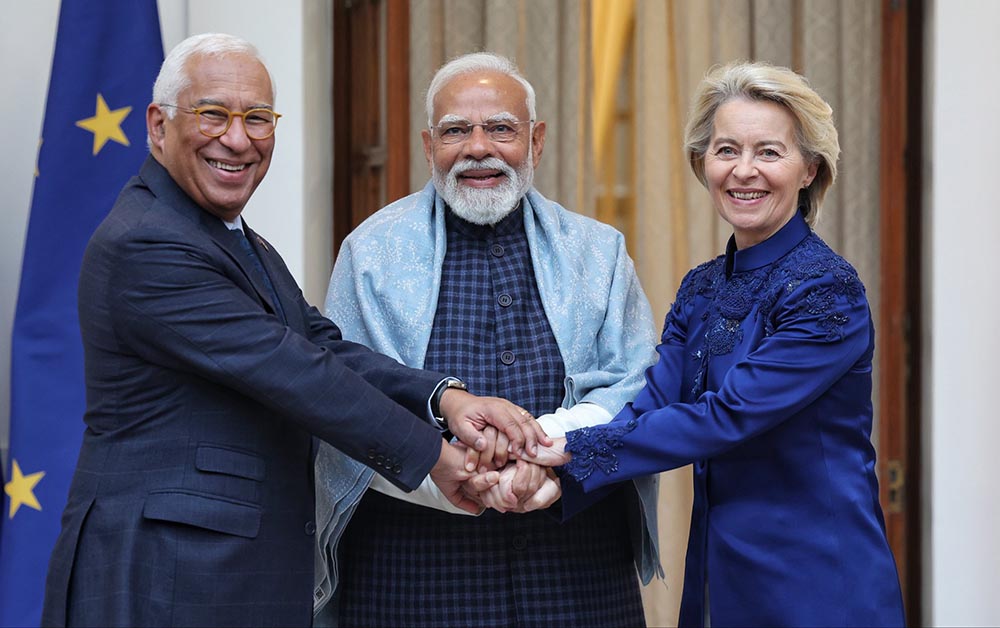
Kathmandu – India and the European Union (EU) have officially signed a historic Free Trade Agreement (FTA), marking a significant milestone in global economics. Indian Prime Minister Narendra Modi announced the deal, describing it as the largest free trade agreement in India’s history. Spanning across 27 EU member states, the Prime Minister highlighted that this partnership represents two of the world’s largest economies coming together, accounting for approximately 25% of global GDP and nearly one-third of global trade.
The signing ceremony was attended by European Council President António Luís Santos da Costa and European Commission President Ursula von der Leyen, both of whom served as chief guests at India’s Republic Day celebrations.
Prime Minister Modi emphasized that the agreement is a shining example of synergy between major economies, reinforcing a shared commitment to democracy, the rule of law, and a strengthened global supply chain. He noted that key Indian sectors—including textiles, gems and jewelry, leather, and footwear—stand to benefit immensely from this deal. According to the Indian government, this move is expected to bolster the confidence of global investors and businesses in the Indian market.
European Council President Costa echoed these sentiments, noting that in a changing world order, India has emerged as a reliable partner and a rapidly growing economy, suggesting that the deal will benefit over two billion people and contribute to global peace.
European Commission President Ursula von der Leyen hailed the agreement as the “mother of all deals,” stating that India and Europe have made history together. The timing of the agreement is particularly strategic, as both India and the EU have recently faced trade tensions with the United States.
Under the terms of the deal, India will provide the EU with unprecedented tariff concessions. For instance, customs duties on cars will be slashed from 110% to 10%, while duties on car parts will be phased out entirely over the next five to ten years. Significant tariff reductions are also set for machinery (up to 44%), chemicals (up to 22%), and pharmaceuticals (up to 11%). Additionally, the agreement restores the Generalized Scheme of Preferences (GSP), allowing many products from developing regions to enter the European market duty-free.





FACEBOOK COMMENTS