
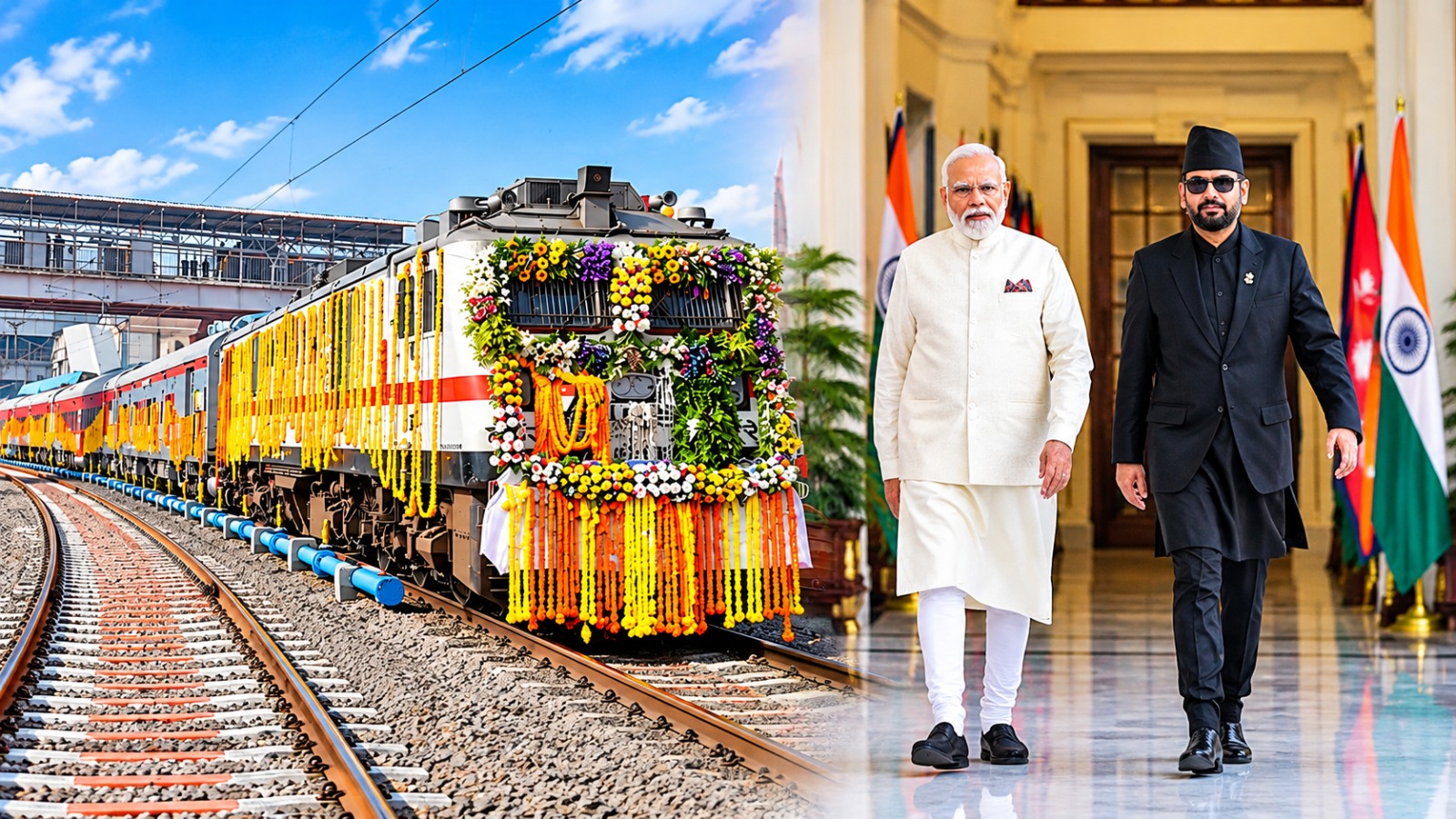
Kathmandu: Plans to strengthen Nepal-India rail connectivity, a subject that dates back to the Rana era, are gaining fresh momentum nearly a century later, with three major railway initiatives receiving renewed attention during Prime Minister Balen Shah’s two-day visit to India.
During the November 22–23 visit, Nepal and India agreed to advance three key railway initiatives, including the expansion of the East-West Railway Network, the completion of ongoing cross-border railway projects, and progress on the Raxaul-Kathmandu railway project. The Ayodhya-Janakpur railway service has also been inaugurated, marking a new chapter in cross-border religious connectivity.
Following the visit, Prime Minister Shah returned to Nepal, while the newly inaugurated Ayodhya-Janakpur train arrived in Janakpur on Tuesday.
A joint statement issued after bilateral talks between Prime Minister Shah and his Indian counterpart Narendra Modi highlighted railway connectivity as an important means of strengthening trade, tourism and economic cooperation between the two countries.
If implemented effectively, the agreements could help reduce transportation costs, promote religious tourism and improve Nepal’s access to international markets through India’s extensive railway network.
The Ayodhya-Janakpur railway service has been launched to strengthen the religious and cultural ties between Nepal and India through improved transportation connectivity.
The train, named the Sarayu-Kamala Express, was jointly inaugurated virtually by the prime ministers of both countries on Monday. It arrived at Janakpur Railway Station at 9:40 am on Tuesday.
The train departed from Ayodhya at 12:30 pm on Monday and travelled through several stations in Uttar Pradesh and Bihar before reaching Nepal. Cultural programmes and traditional processions were organised in Janakpur to welcome the train.
Covering a distance of approximately 604 kilometres, the train passes through several stations, including Mankapur, Basti, Gorakhpur, Narkatiaganj, Raxaul, Sitamarhi, Shisho, Madhubani and Jayanagar. The service will operate once a week.
The 17-coach train offers several passenger accommodation options, including sleeper class, AC three-tier, AC three-tier economy and AC two-tier facilities.
Directly connecting Ayodhya, regarded as the birthplace of Lord Ram, with Janakpur, the birthplace of Goddess Sita, the service is expected to boost religious tourism. It could particularly benefit the Ramayana Circuit by attracting more visitors from India and other countries.
An increase in tourist arrivals could generate economic opportunities for Janakpur and the wider Madhesh Province, particularly in the hospitality, transportation and local business sectors.
Nepal and India have also agreed to explore possibilities for connecting Buddhist and Shiva-Shakti religious tourism circuits with their expanding transportation networks.
The idea of connecting Raxaul with Kathmandu by railway is not new. During the Rana era, the Raxaul-Amlekhgunj railway service was already in operation. However, despite repeated discussions over the years, the extension of the railway line to Kathmandu has yet to move into the construction phase.
The project gained formal momentum on March 22, 2018, following the India visit of then Prime Minister KP Sharma Oli. Subsequently, during Indian Prime Minister Narendra Modi’s visit to Nepal in September 2018, the two countries reached an understanding to conduct a preliminary engineering and traffic survey.
After India submitted the preliminary study report in 2019, an agreement was signed in 2021 to conduct the Final Location Survey (FLS).
Field studies began in February 2022, and the final survey report was submitted to the Nepal government in July 2023. During Prime Minister Shah’s recent India visit, both countries formally announced the completion of the survey process.
According to the study conducted by Konkan Railway Corporation, the proposed railway line will be approximately 136 to 140.79 kilometres long.
The proposed route will pass through Parsa, Bara, Makwanpur and Lalitpur before reaching the Kathmandu Valley, with Chobhar and Khokana identified as areas for the railway’s proposed terminal infrastructure.
Although the completion of the survey marks an important milestone, construction, investment arrangements and further technical preparations will be necessary before the railway becomes operational.
Under the third major railway agreement, Nepal and India have agreed to prioritise the expansion of Nepal’s East-West Railway Network.
The two countries aim to develop interoperable railway infrastructure that will allow trains to operate smoothly across their respective railway systems.
The Bardibas-Nijgadh and Birgunj-Nijgadh sections have been identified for further progress. Both sides have also committed to expediting the remaining construction work on the Jayanagar-Bardibas and Jogbani-Biratnagar railway projects.
Currently, the Jayanagar-Janakpur railway service is operational. India is constructing the remaining section between Bijalpura and Bardibas, while the Nepal government is developing approximately 70 kilometres of railway infrastructure between Bardibas and Nijgadh.
Once these sections are completed, railway connectivity could be extended through Janakpur, Bardibas, Nijgadh and Birgunj towards Raxaul.
The expanded network is expected to facilitate the transportation of agricultural and industrial products from eastern Nepal and Madhesh Province to Indian markets, while also strengthening cross-border trade.
The latest agreements between Nepal and India have renewed prospects for railway development and regional connectivity. However, translating these commitments into reality will require Nepal to establish a clear investment strategy, complete technical preparations and develop a time-bound implementation plan.




FACEBOOK COMMENTS