
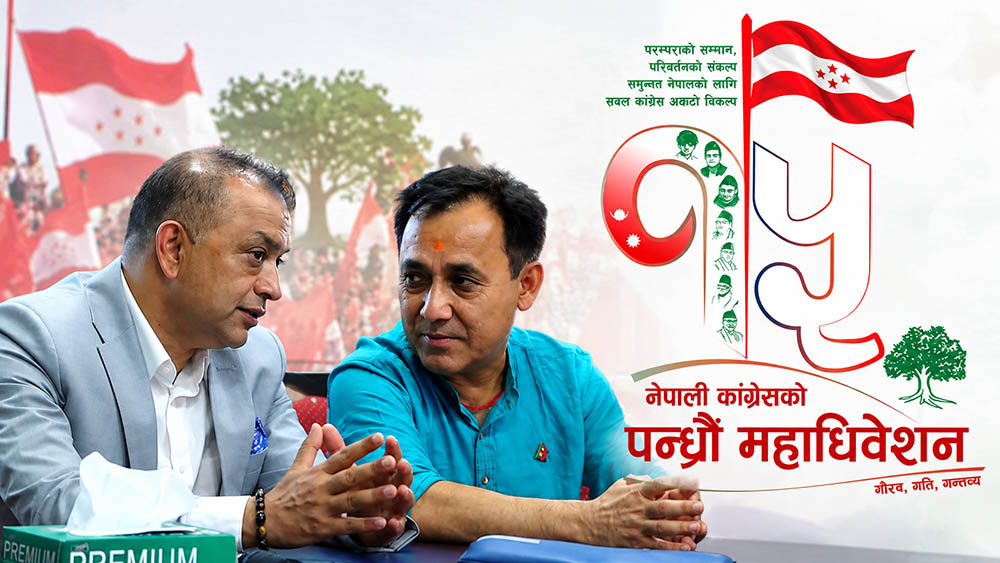
KATHMANDU: A large number of Nepali Congress leaders and activists who stayed away from the party’s special convention in January have now returned to the mainstream and are preparing to participate in the party’s 15th general convention, which begins Sunday at Khula Manch in Kathmandu.
The special convention, held from January 11 to 14, elected Gagan Thapa as party president. About 54 percent of the party’s representatives from across the country had participated in the convention. Of the 167-member central working committee led by then-party president Sher Bahadur Deuba, only 30 members had attended.
Eight months later, the political landscape within the party has changed significantly.
Around 70 additional central members who had stayed away from the special convention have since joined the central working committee led by Thapa. Nineteen former office-bearers and central members joined on May 11, while another 51 joined on September 17.
Nepali Congress spokesperson Devraj Chalise said almost all party leaders and activists would participate in the 15th general convention.
“This is a unity convention. The divisions that existed during the special convention have largely disappeared,” Chalise said. “Who attended and who did not attend the special convention is no longer an issue. The Congress is now united.”
According to Chalise, enthusiasm for the convention has increased across the country, with leaders and cadres from different factions preparing to participate in the organisational process.
The development has significantly weakened the position of former party president Sher Bahadur Deuba, who previously commanded the support of a large number of senior Congress leaders.
Many politicians who had earlier supported Deuba have now aligned themselves with the Thapa-led establishment and are preparing to participate in the 15th general convention.
Former central committee member Shyam Ghimire, who was previously associated with the Deuba faction, said the party was entering the convention as a united organisation.
“Many colleagues have come together with the objective of making the party more organised, stronger and united,” Ghimire said. “The situation has changed across the districts, and the rank and file are in favour of party unity.”
Deuba has also lost the backing of several senior leaders who had previously stood by him. Former acting president Purna Bahadur Khadka and leader Shekhar Koirala have distanced themselves from his faction.
Among senior leaders, Deuba is now mainly backed by Shashank Koirala, Krishna Sitaula, Bimalendra Nidhi and Prakash Man Singh. Leaders from the second tier supporting him include NP Saud, Ramesh Lekhak, Prakash Sharan Mahat, Mohan Bahadur Basnet, Shankar Bhandari, Deepak Khadka and Jeet Jung Basnet.
Shekhar Koirala, who had challenged Deuba for the party presidency at the 14th general convention, initially continued to support him after the special convention and participated in meetings organised by the Deuba faction. More recently, however, he has stayed away from both parallel convention processes.
As Koirala withdrew from the convention process, many former central members who had previously supported him also joined the Thapa-led convention.
Purna Bahadur Khadka, who had emerged as the second-ranking leader in the Deuba faction after serving as acting party president, has likewise stayed away from both parallel conventions.
Several former ministers and central members who had previously been associated with Deuba have also shifted toward the Thapa-led convention. They include Bal Krishna Khand, Gyanendra Bahadur Karki, Mahalakshmi Upadhyay ‘Dina’, Surendra Raj Pandey, Kishor Singh Rathore, Indra Bahadur Baniya, Jeevan Bahadur Shahi, Shyam Ghimire, Min Bahadur Bishwakarma, Nain Singh Mahar, Sita Kumari Rana, Anil Rungta and Ganesh Lama.
Leaders including Ishwari Neupane, Ramhari Khatiwada, Sita Gurung and Minakshi Jha have also joined the Thapa-led convention.
Former vice president Dhan Raj Gurung and former central members Minendra Rijal, Dipak Giri, Govinda Bhattarai, Krishna Chandra Nepali, Kiran Yadav, Rukmini Koirala and Tek Prasad Gurung, who had previously been associated with the Shekhar Koirala camp, are also participating in the convention.
Bishwakarma, who remained with Deuba until late in the process, said he was joining the convention with the aim of strengthening party unity.
“There is no longer an issue of who belongs to which faction,” Bishwakarma said. “Everyone is Congress.”
Of the 164 members of the previous Deuba-led central working committee, only around 31 are now said to remain with him.
Thapa had already begun incorporating members of the previous central committee into the new organisational structure ahead of the general convention. On May 11, he nominated 19 former office-bearers and central members associated with the Deuba, Shekhar Koirala and Shashank Koirala camps.
Eleven of those nominated were from the Deuba camp and seven from the Koirala camp. They included Mahendra Yadav, Umesh Shrestha, Ramesh Rijal, Ajay Kumar Chaurasiya, Laxmi Pariyar, Angelu Sherpa, Dinesh Kumar Yadav, Rajiv Dhungana, Sushila Mishra Bhatta, Nagina Yadav and Jeevan Rana. Yadav had served as Deuba’s general secretary, while Shrestha had served as treasurer.
Former supporters of Shekhar Koirala, including Jeevan Pariyar, Sujata Koirala, Dilli Bahadur Chaudhary, Chandra Kanta Bhandari, Rajiv Koirala, Govind Raj Pokharel and Dinsh Koirala, were also appointed central members.
Sita Thapaliya ‘Urmila’, who was regarded as close to Shashank Koirala, was also appointed to the central committee.
Former central member Govinda Pokharel said more than 80 percent of Congress leaders and activists nationwide had returned to the mainstream by the time the party moved from local-level conventions toward the general convention.
Despite losing much of his previous support, Deuba is continuing with a separate convention process.
The Thapa-led faction is holding the 15th general convention from October 4, while the Deuba faction has announced plans to hold its own general convention from December 7 to 9.
The development has left the Nepali Congress facing two parallel convention processes.
Supporters of Deuba argue that the dispute is not simply about factional politics but concerns which organisational process is legally valid.
The competing convention processes have deepened the organisational divide within Nepal’s oldest major political party, even as a large number of leaders and activists from different factions have moved toward the Thapa-led convention.












FACEBOOK COMMENTS