
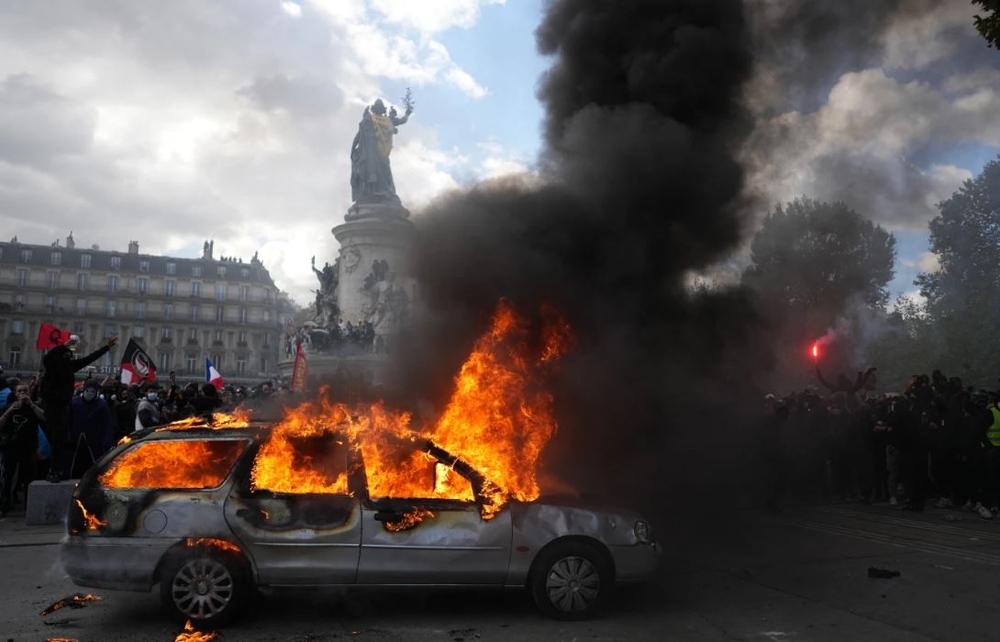
PARIS: More than 550,000 people took to the streets across France on Saturday, October 17, including around 125,000 in the capital, Paris, in a wave of protests driven by rising living costs, fuel prices, concerns over the education system, and growing dissatisfaction with the government.
The demonstrations, which brought together students, parents, workers and supporters of the Yellow Vest movement, escalated into clashes, vandalism and looting in some areas. Protesters were heard chanting slogans against the police and demanding the resignation of President Emmanuel Macron.
According to French police, 855 protesters were detained in Paris alone, with more than 500 reportedly remaining in custody. Among those detained were 171 minors. Prosecutors said many faced allegations related to theft, violent acts and damage to public and private property.
One protester reportedly died after suffering a cardiac arrest. Another sustained severe injuries, including the loss of a hand, after a grenade used in riot control exploded. Interior Minister Laurent Nuñez said more than 500 security personnel, including police officers and firefighters, had been injured.
The latest unrest can be traced to growing concerns about public education and the rising cost of living.
In the third week of September, students at a school in Créteil, a town southeast of Paris, staged a small demonstration over teacher shortages and poor classroom conditions. Videos of the protest spread rapidly on social media, turning a local complaint into a national issue within days.
Students’ groups, parents and education advocates subsequently raised concerns about overcrowded classrooms, insufficient teachers, inadequate school infrastructure and the quality of public education.
The movement gained momentum as different groups organized demonstrations around related grievances. A major protest on October 6 reportedly left 215 young people, 85 teachers and other school employees, and more than 700 police officers injured.
A student protest planned for October 13 and a separate demonstration scheduled for October 17 over the cost of living and fuel prices eventually converged. The participation of the Yellow Vest movement further broadened the protests.
The Yellow Vest movement, known in French as Gilets jaunes, emerged in 2018 in response to the government’s plans to increase fuel taxes.
The proposed tax increases particularly affected people who depended on cars for daily commuting and work, including drivers and transport workers. On November 17, 2018, protesters wearing high-visibility yellow jackets launched nationwide demonstrations.
The movement soon expanded beyond fuel prices, becoming a broader expression of frustration with economic policies, household expenses and the perceived disconnect between the government and ordinary citizens.
The protests posed a major political challenge to Macron’s government, which eventually abandoned the planned fuel-tax increases.
The movement’s renewed participation in the October 17 demonstrations reflects continuing concerns about fuel prices, energy costs and the affordability of everyday life.
The protests come at a difficult time for the French government. The country has a minority government that faces challenges in securing parliamentary support for its 2027 budget, while opposition parties have resisted proposed spending cuts.
Meanwhile, high fuel and energy prices and the rising cost of living have intensified public frustration.
The French government’s own projections reportedly put the country’s budget deficit at 5.4 percent of gross domestic product in 2026, adding to concerns over public finances.
The timing is also politically significant, with France’s next presidential election scheduled for April 2027. Macron is constitutionally barred from seeking a third consecutive presidential term.
Although the protests do not necessarily determine the outcome of the next election, widespread demonstrations and calls for the president’s resignation could influence the political debate, shape public perceptions of the government and affect the positions of competing political parties.
France was not the only European country to witness demonstrations on Saturday. In Belgium, protesters raised concerns about problems in education, rising study costs and the risk of reduced access to higher education. Demonstrations over university registration fees had already been continuing for several weeks.
In Italy, protests against wars around the world and the rising cost of living were accompanied by clashes between demonstrators and police. Some participants were reported to have engaged in arson and looting.
In Portugal, tens of thousands of people reportedly protested over the increasing cost of living, low wages and difficulties in securing affordable housing. Housing purchase prices and rents have risen sharply, with prices reported to have more than doubled since 2017.
Other demonstrations have also taken place in countries including Albania and Argentina, where protesters have raised demands ranging from political accountability to opposition against university budget cuts.
Taken together, these events highlight the different economic, social and political pressures confronting governments in several countries.
Some observers have compared the demonstrations in France and other countries with Nepal’s Gen-Z movement because both involve large-scale public mobilization and dissatisfaction with established political institutions.
However, the immediate causes differ. Nepal’s Gen-Z protests were driven primarily by anger over corruption, nepotism and governance-related concerns. In France, the current demonstrations have brought together several grievances, particularly rising living costs, fuel and energy prices, and problems in the education system.
In other countries, protesters have focused on issues such as housing affordability, low wages, university funding and opposition to war. Despite these differences, the protests share a broader theme: growing public pressure on governments to respond to concerns affecting people’s daily lives.
The demonstrations also illustrate how social media can help local grievances spread rapidly, connect different groups and turn isolated complaints into nationwide movements.
For France, the immediate challenge is to address the concerns behind the demonstrations while maintaining public order. The longer-term question is whether the government and political parties can respond to public dissatisfaction over living costs, education and economic policy ahead of the 2027 presidential election.












FACEBOOK COMMENTS