
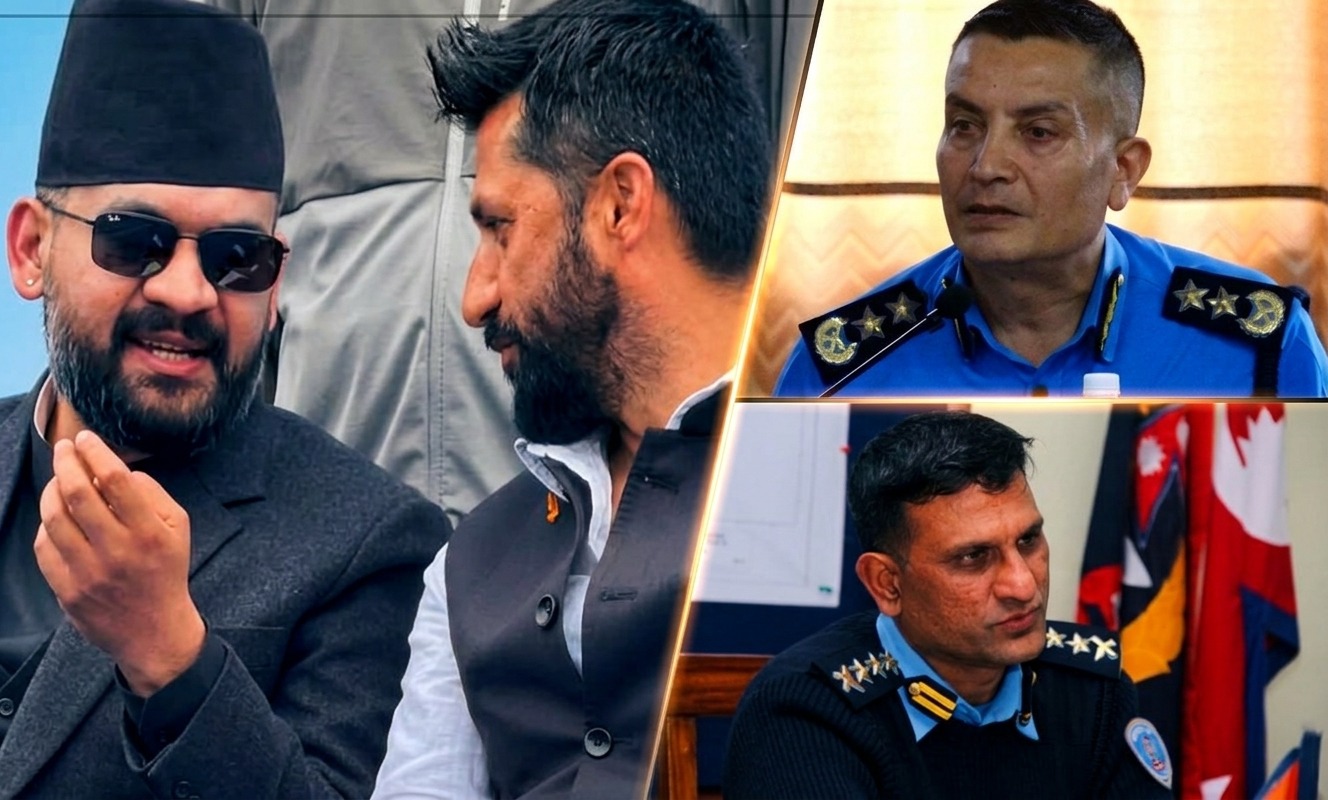
KATHMANDU: Debate has intensified over political interference in Nepal Police and its potential consequences following reports that Prime Minister Balendra Shah is seeking to remove Inspector General of Police (IGP) Dan Bahadur Karki before the completion of his tenure.
The reports have raised questions about police leadership, institutional integrity and the relationship between the government and the police force.
Media reports have suggested that Prime Minister Shah held discussions with Rastriya Swatantra Party (RSP) Chairperson Rabi Lamichhane on Wednesday night regarding the possibility of removing Karki and appointing a new police chief. The issue drew further attention after the Nepal Police Headquarters reportedly summoned senior officials, including police chiefs from all seven provinces, to Kathmandu early Thursday.
What impact could political interference have on the morale of the police force, public trust and national security? What would be the legal and institutional consequences if the IGP were removed before the end of his tenure?
Corporate Khabar spoke with former Nepal Police Deputy Inspector General (DIG) Ramesh Kharel to discuss these issues. Edited excerpts:
Prime Minister Balendra Shah is reportedly seeking to remove IGP Dan Bahadur Karki, whose tenure is said to have more than a year remaining. Media reports have also suggested that the Prime Minister discussed the matter with RSP Chairperson Rabi Lamichhane after concluding that he could no longer work with the current police chief. How do you view this development, given your long experience in Nepal Police? What impact could the dismissal of the IGP have?
I do not have any concrete information about this matter at the moment. I have also been following the developments through newspapers and media reports. There have been reports that efforts are being made to remove the IGP, that he is being pressured to resign and that the government is exerting pressure on him.
Such developments would certainly have an impact on the police organisation. However, it is also important to understand why the government is considering such a move. At this stage, I am not in a position to draw any definitive conclusion about the situation.
Reports about the Prime Minister’s attempt to remove the IGP emerged around the same time as a meeting between Balendra Shah and RSP Chairperson Rabi Lamichhane. Subsequently, a meeting was held at the Police Headquarters, and police chiefs from all seven provinces were reportedly summoned to Kathmandu on Thursday. How should these developments be understood?
Based on my experience, the issues you have raised need to be taken seriously. We have also heard about allegations and counter-allegations involving Khagendra Sunar and the current head of the police organisation. Khagendra has reportedly made allegations, while the police chief has denied them.
When such sensitive issues become public, the government must establish the facts. An impartial investigation should determine whose claims are valid, and the findings should also be communicated to the public.
If Khagendra is at fault, action should be taken against him. If Dan Bahadur is at fault, action should be taken against him. Nobody is above the law.
However, it is not appropriate to leave such matters unresolved for a prolonged period. The issue should be brought to a logical conclusion as soon as possible. Otherwise, the reputation and institutional standing of Nepal Police could suffer further damage.
Regarding the meeting at the Police Headquarters and the summoning of provincial police chiefs, these could also be part of routine organisational procedures. They may have been called to discuss regular police operations or matters related to this particular controversy. However, I do not have any official information about the actual reasons behind these developments. Therefore, it would not be appropriate to draw conclusions based merely on speculation.
The IGP reportedly has more than a year remaining in his tenure. If the government attempts to remove him before its completion, it could face legal challenges. Some observers have compared the situation with the controversial Katwal episode of the past, suggesting that such a move could create difficulties for the government itself. What is your assessment?
The Katwal episode and the current situation are different. The two incidents should not be viewed from the same perspective.
The Katwal episode involved a dispute between the government led by then Prime Minister Pushpa Kamal Dahal ‘Prachanda’ and then Chief of Army Staff Rookmangud Katawal. At that time, the government attempted to remove Katawal from his position against his will. The central issue was the government’s attempt to dismiss the army chief.
The current controversy, however, is related to allegations reportedly made against the head of Nepal Police. Therefore, the nature and background of the two incidents must be understood separately.
There are reports that IGP Dan Bahadur Karki has been accused of widespread corruption in the recruitment process for election police personnel. If such allegations have been made, questions must be raised about what the Commission for the Investigation of Abuse of Authority (CIAA) and other relevant agencies are doing.
Any allegations must be investigated impartially. If they are substantiated, the individuals responsible should face action in accordance with the law. However, if the allegations are not proven, the individual concerned should not be unfairly declared guilty.
Unlike the Katwal episode, the present controversy involves allegations of corruption in the recruitment of election police personnel against IGP Dan Bahadur Karki. Therefore, the first priority should be to establish the facts.
If the allegations are true, action must be taken. If they are false, he should not be unnecessarily held responsible. Decisions by the state must be based on evidence, legal provisions and impartial investigations.
The same principles must apply to any decision concerning a sensitive matter such as a change in the leadership of the police organisation.





FACEBOOK COMMENTS