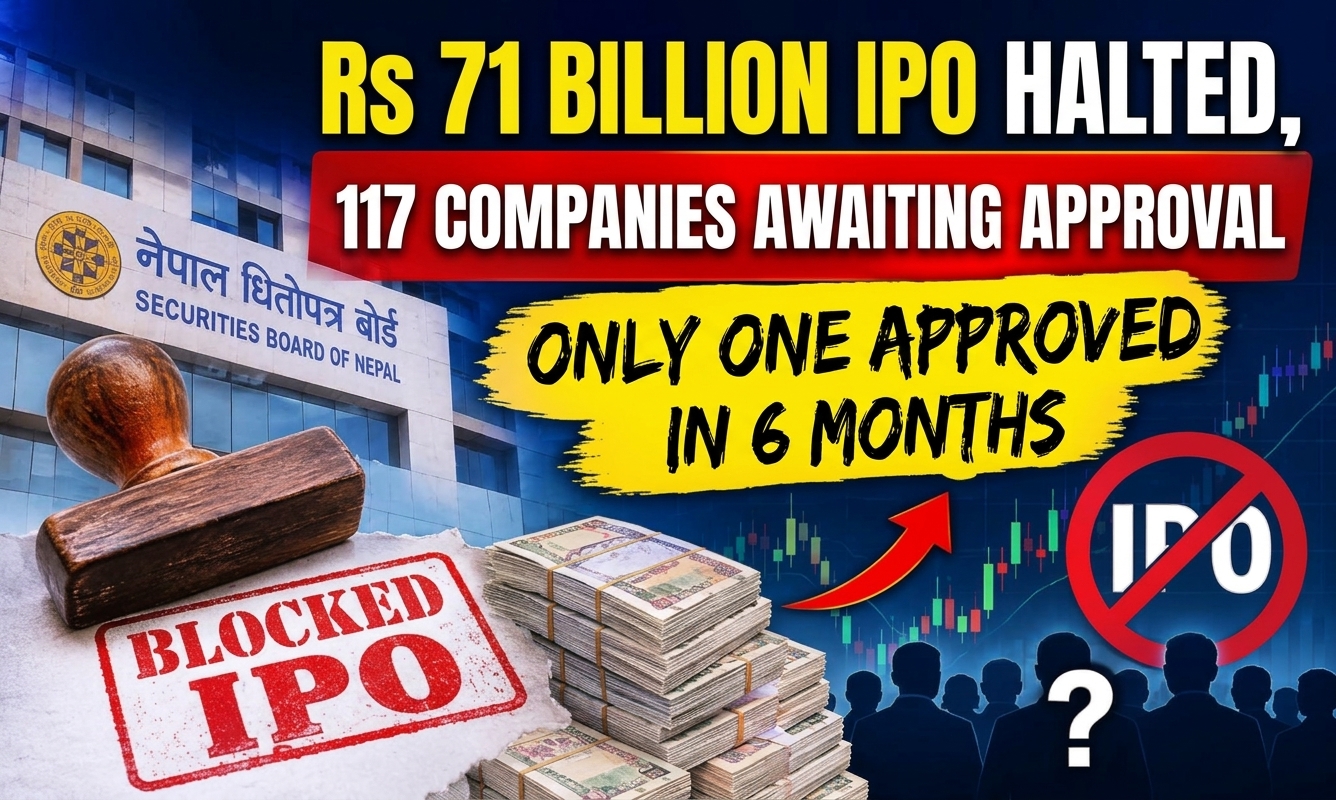
Kathmandu: A total of 117 companies are awaiting approval from the Securities Board of Nepal (SEBON) to issue initial public offerings (IPOs) worth Rs 71.13 billion, involving approximately 510 million shares. However, the board has approved the IPO issuance of only one company in the past six months.
From Baisakh 2 to Asoj 20, only one company received permission to issue an IPO, highlighting the difficulties faced by new companies seeking to enter Nepal’s capital market.
Most companies that have applied for IPO approval have proposed issuing shares at the face value of Rs 100 per share. Some, however, have sought permission to issue shares at a premium.
SEBON requires companies seeking IPO approval to meet various standards, including financial soundness, managerial capacity and other regulatory requirements. Recently, the board has prioritised the examination of documents and financial statements submitted by applicant companies. It has also begun assessing the long-term business prospects of hydropower companies, including the operational lifespan of their projects and their status after the concession period expires.
According to the board’s published details, 12 applicant companies have submitted all the required documents. Of these, nine have met the minimum net worth requirement of Rs 100 per share.
The nine companies are Sanima Hydropower, IME Limited, Richet Hydropower, Him River Power, Hilton Hydropower, Habitat Power, NC Agrotech, Ashutosh Energy and Kantipur Pharmaceuticals.
Their net worth per share ranges from Rs 105 to Rs 263.61. All nine companies have proposed issuing their IPOs at the face value of Rs 100 per share.
Despite submitting the necessary documents and meeting the minimum net worth requirement, these companies have yet to receive approval. SEBON has maintained that completing documentation alone does not guarantee approval. The board must also verify the accuracy of submitted information and conduct on-site inspections where necessary.
Meanwhile, 76 companies have been asked to provide additional details and update their documents. Through their share issuance and sales managers, these companies have been instructed to submit updated financial statements, audit reports and documents related to their management. They must also provide audited financial reports or auditor-certified financial statements for fiscal year 2082/83, along with compliance reports demonstrating that they meet the required standards.
Hydropower companies account for the largest number of IPO applications awaiting approval. A total of 39 hydropower companies have applied to issue shares worth Rs 19.09 billion.
Similarly, 32 companies from the manufacturing and processing sector have sought approval to issue IPOs worth Rs 35.71 billion. Although hydropower companies lead in the number of applicants, manufacturing and processing companies account for the largest proposed issuance amount.
Currently, 18 companies from the manufacturing and processing sector are listed on the Nepal Stock Exchange (NEPSE). Another 32 companies are seeking to enter the capital market through IPOs.
SEBON has recently adopted a more cautious approach towards approving IPOs of hydropower companies. The board has prioritised an assessment of project operating periods and the commercial prospects of companies after their projects reach the end of their operating licences.
Under the existing arrangements, ownership of hydropower projects is generally transferred to the government after the licence and operating period expire. This has raised questions about the long-term business prospects of the companies and the status of shares held by ordinary investors after the project handover.
Previously, hydropower companies were required to reserve up to 10 percent of their issued capital for residents of project-affected areas. However, delays in IPO approval have also affected the process of distributing shares to local residents.
Banks, financial institutions and insurance companies are required under regulatory provisions to issue at least 30 percent of their shares to the general public. Meanwhile, applications from three microinsurance companies seeking IPO approval have also remained pending.
In 2073 BS, SEBON introduced a policy aimed at encouraging real-sector and manufacturing companies to enter the capital market. Under the provision, eligible manufacturing companies meeting specified conditions were allowed to enter the capital market by issuing as little as 10 percent of their shares to the public.
The policy was introduced to make the financial transactions of manufacturing industries more transparent, help companies raise the capital they need and increase the representation of the real sector in the share market.
Following the policy, some private companies began converting into public limited companies and preparing to issue IPOs. However, among the companies currently awaiting approval, manufacturing and processing companies have applied to raise the largest amount of capital through public offerings.
While policies have been introduced to encourage new companies to enter the capital market, prolonged delays in IPO approvals have affected plans to raise funds for business expansion and investment in the manufacturing and hydropower sectors.



FACEBOOK COMMENTS