
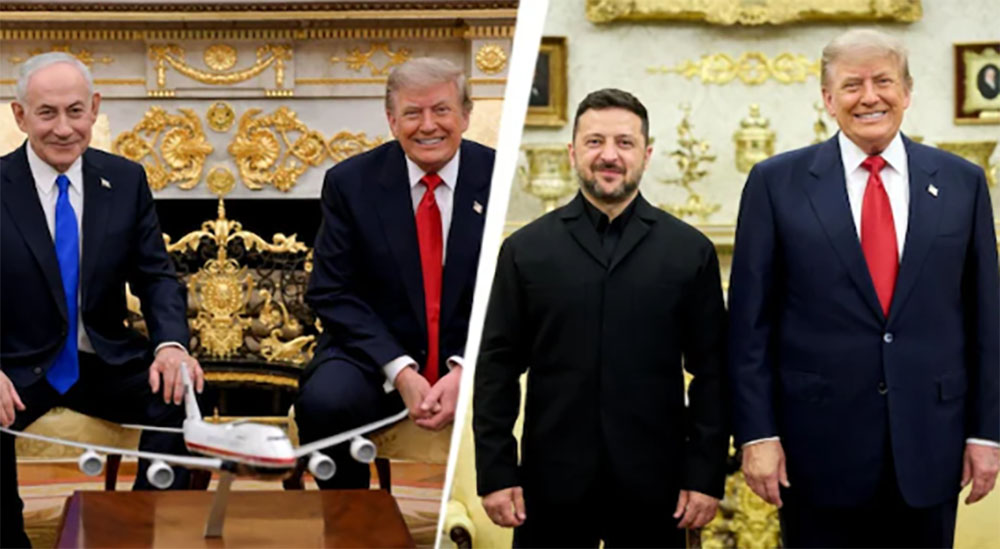
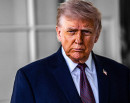
Kathmandu. U.S. President Donald Trump held separate meetings with Ukrainian President Volodymyr Zelenskyy and Israeli Prime Minister Benjamin Netanyahu in the Oval Office at the White House. The meetings are viewed as significant at a time when rising tensions in West Asia and the Russia-Ukraine war stand as major global challenges.
White House Press Secretary Karoline Leavitt stated via social media that President Trump completed his meetings with both leaders, describing both discussions as positive and productive.
Both Zelenskyy and Netanyahu traveled to the United States to attend the funeral of late Senator Lindsey Graham. Taking advantage of the occasion, they discussed critical matters related to their respective countries with President Trump.
Lindsey Graham was regarded as a staunch supporter of Israel and a vocal critic of Iran. Just a day before his passing, he had met with Zelenskyy in Kyiv. He was also working on a Senate bill regarding tougher sanctions against Russia.
Prior to the meeting, Netanyahu stated on social media that his objective was to ensure Israel’s security, further strengthen the nation’s power, and expand the realm of peace. Describing Graham as a true friend of Israel, he also mentioned that he would pay tribute to him while in the U.S.
This is Netanyahu’s first visit to Washington since February. Following a previous meeting, tensions and military conflict between the United States and Iran had escalated for an extended period.
According to reports, while both leaders appeared aligned on most issues at the start of Trump’s second term, differences on several issues have become public in recent weeks.
Trump once went so far as to call Netanyahu “crazy” and expressed that “without me, Israel wouldn’t even exist.”
Claims suggest that Netanyahu was not consulted in advance regarding the ceasefire agreement with Iran or the reopening of the Strait of Hormuz. Similarly, Israeli officials have expressed dissatisfaction over proposed U.S. plans for potential nuclear energy cooperation with Saudi Arabia and the sale of F-35 fighter jets to Turkey.
However, Trump stated that no one else can determine what the U.S. decides to sell to whom. When asked about differences regarding Iran, he noted that while there are varying views on certain subjects, they agree on most issues.
Trump and Zelenskyy had previously met earlier this month during the North Atlantic Treaty Organization (NATO) summit in Ankara, Turkey.
During this meeting, detailed discussions were held on potential ways to end the Russia-Ukraine war as well as the supply of essential weapons and missiles to Ukraine.
In recent weeks, Zelenskyy has been urging the U.S. to rapidly deliver military assistance, warning that weapon shortages in Ukraine have heightened the risk of Russian attacks.
Earlier, Trump announced that Ukraine would be allowed to produce Patriot air defense missile interceptors domestically—a permission Ukraine had long been seeking.
Trump rejected reports claiming that U.S. stockpiles of air defense missiles are depleting. Placing the responsibility on former President Joe Biden, Trump stated that because the Biden administration provided vast quantities of weapons to Ukraine, the U.S. is currently working to rebuild its own stockpiles.
He claimed that the U.S. possesses adequate quantities of various weaponry, including an excess of medium-range weapons beyond requirements, adding that he intends to produce even more arms.
Zelenskyy claimed that Ukrainian forces targeted ships carrying Iran-related military equipment in the Caspian Sea region, as well as a Russian warship.
Following this, Iranian Foreign Minister Abbas Araghchi warned of a response to the attack, calling it an action contrary to the United Nations Charter.
Zelenskyy also accused Russia of providing satellite intelligence to Iran to assist in targeting U.S. military bases in West Asia.
Responding to this, Trump stated that he would speak directly with Russian President Vladimir Putin on the matter. Mentioning that the truth would soon come to light, he claimed that even if such assistance occurred, it had little impact because the U.S. had inflicted massive damage on Iran.
Zelenskyy claimed that Ukraine possesses evidence showing Russia has conducted satellite surveillance of U.S. military bases and partner nations in the Arabian Gulf region since early July. He alleged these intelligence links to Iranian attacks, though the White House has made no official comment on the matter.
Earlier, Trump stated he believed Russian President Putin and Chinese President Xi Jinping were not providing large-scale assistance to Iran.












FACEBOOK COMMENTS