
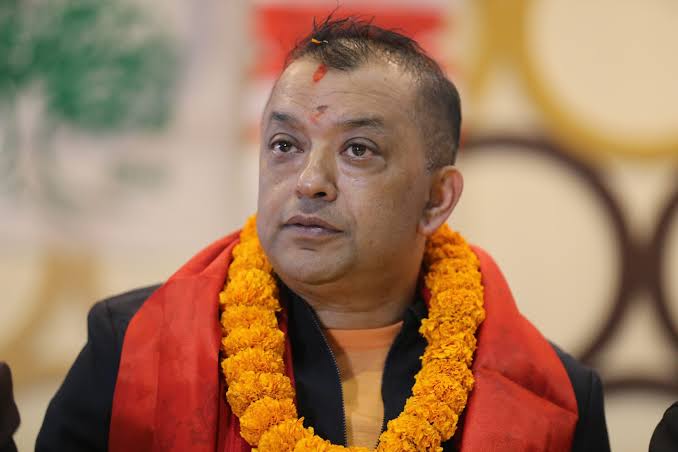
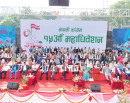
Kathmandu: Gagan Thapa has been elected president of the Nepali Congress with a decisive majority at the party’s 15th General Convention, securing 6,584 votes in an election held on Friday.
According to a statement signed by Central Election Committee Coordinator Prem Bahadur Khadka and members Sujan Lopchan and Raju Khadka, Thapa was declared elected on Saturday.
His rival, Shyam Krishna Khadgi, received 375 votes, giving Thapa a lead of 6,209 votes.
The election committee stated that Thapa secured 93.88 percent of the votes, while Khadgi received 5.35 percent.
Following Thapa’s victory, senior vice-president-elect Bishwo Prakash Sharma congratulated him through social media, describing the election as the beginning of a journey rather than its final destination.
Sharma stressed the need to strengthen party unity, address past weaknesses, respect differing opinions and work towards national prosperity. He also pledged his support for Thapa’s leadership.
Similarly, Nepali Congress leader Pradip Paudel congratulated Thapa, describing his election as a historic responsibility to take the party to new heights.
Another leader, Uday Shumsher Rana, expressed his commitment to working under Thapa’s leadership to strengthen party unity and internal democracy and translate public trust into national prosperity and a brighter future for citizens.
Political analyst Chandra Kishore said the 15th General Convention had sent two messages: continuity with the party’s established traditions and acceptance of new leadership.
He argued that Thapa’s major challenge would be to bring more party members together under his leadership, engage with younger generations and reassure senior leaders that their contributions would be respected.
He also highlighted the need to reconnect with leaders and members who remained outside the convention and to address dissenting voices constructively to expand public trust in the party.
Thapa’s election comes amid a prolonged dispute within the Nepali Congress.
A special convention held in Kathmandu in January, amid strong opposition from the faction led by Sher Bahadur Deuba, elected Thapa unopposed as party president. The committee formed under his leadership subsequently organised the 15th General Convention.
Deuba’s faction had questioned the legitimacy of the special convention, describing it as a gathering rather than a formal party convention. However, the Supreme Court later recognised the committee led by Thapa, while the Election Commission also recognised the leadership elected through the special convention.
Deuba and leaders aligned with him subsequently pursued separate party activities and announced plans for a parallel convention.
Despite the divisions, several leaders previously considered close to Deuba, including Balkrishna Khand, Gyanendra Bahadur Karki, Min Bishwakarma, Mahalaxmi Upadhyaya, Mahendra Yadav and Sita Gurung, participated in the convention.
Thapa now faces the task of consolidating the party, strengthening internal democracy and building broader political support amid continuing factional differences.








FACEBOOK COMMENTS